Our talented team of Museum educators is committed to providing an engaging experience that brings SOL-related content to life for your students. We bring passion and energy to each program to ensure the highest level of impact and retention. To learn more about this program, click on one of the format options listed below.

Choose your experience:
Duration: 2 hours
What can tiny organisms and a sample of lake water tell us about an entire watershed? Students will investigate the health of Mariners’ Lake through place-based scientific inquiry, moving between indoor and outdoor stations to gather evidence about changing landscapes, water quality, ecosystem health, and human impacts.
Tracing Changes at Mariners’ Lake and Park
Inside the Museum, students will join a guided tour with one of our staff, focusing on the history of Mariners’ Lake and Park and how our landscapes and habitats have changed over time.
Investigating Runoff and Watershed Health
At a second indoor station, students will take part in demonstrations to see firsthand how permeable and nonpermeable surfaces impact runoff into Mariners’ Lake. Students will also be encouraged to discuss how they can help positively impact the health of our local watershed.
Testing Water Quality in Mariners’ Lake
Outside, students will write and test a hypothesis by investigating abiotic factors that help indicate the current health of Mariners’ Lake. They will engage with a variety of water-quality tests to gather evidence and make conclusions about conditions in the lake.
Exploring Freshwater Macroinvertebrates
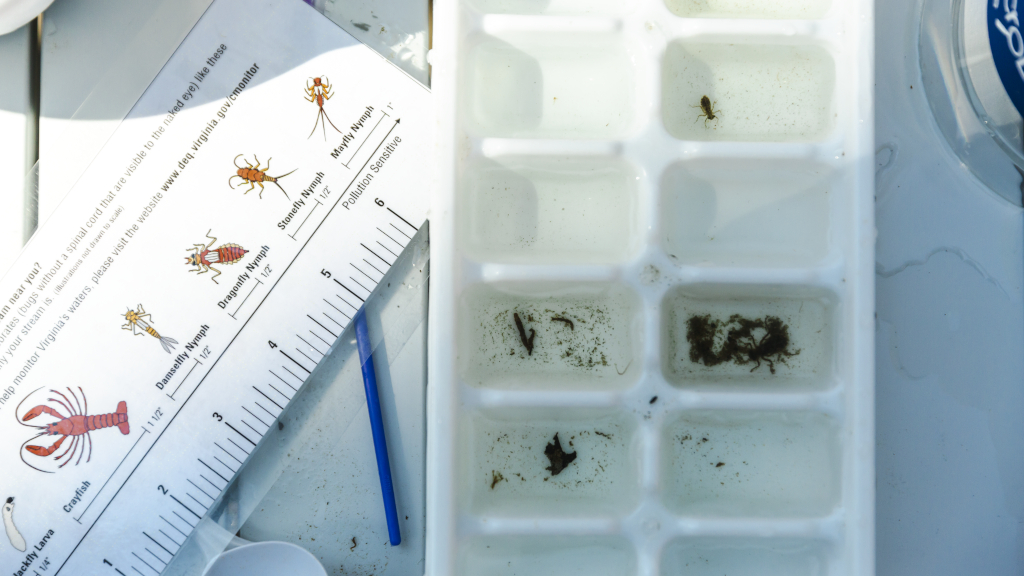
Students will investigate biotic factors by sifting through leaf packs that house freshwater benthic macroinvertebrates found in Mariners’ Lake. Their observations will help them make connections between the organisms living in the Lake and the overall health of the watershed. Teachers, please note: As half of this field trip occurs outside, all students are encouraged to dress for the weather and bring a sealable water bottle..
Learning Objectives
- Students will define abiotic factors and identify key water quality parameters such as turbidity, temperature, nutrient presence, and pH.
- Students will practice skills used by environmental scientists including data collection, recording, analysis, drawing conclusions, and teamwork.
- Students will demonstrate critical thinking by drawing conclusions about water quality based on presence of macroinvertebrates.
- Students will discuss how humans and development impact local watersheds by listing up to three examples.
Science (VDOE 2018):
- Middle: 6.1 (a, b, c, d); 6.6 (d, f); 6.8 (a, b, c, d); 6.9 (a, b, c, e); LS.1 (a, b, c, d); LS.4 (a, b); LS.5 (c); LS.6 (b, d); LS. 7 (a, b); LS.8 (a, c); LS.9 (a, c); LS.11 (a, c)
- High: ES.1 (a, b, c, d); ES.6 (c, d); ES.8 (c, d); ES.10 (e); BIO.1(a, b, c, d); BIO.2 (a); BIO.6 (a, c); BIO.8 (b, d)
Next Generation Science Standards:
- Middle: MS-LS2-2, 4, 5; MS-ESS3-3, 4
- High: HS-ESS3-1, 4
Ocean Literacy Principles
- 1) Earth has one big ocean with many features.
- 6) The ocean and humans are inextricably interconnected.
Pricing:
Payment can be made before the program, or we can invoice following your program.
- Programs at the Museum are $4.50 per student.
All adults accompanying a field trip are free. - Programs at your location are $4.50 per student.
- Virtual education programs are $125 per program.
Reservations are required for all programs and are booked on a first-come, first-served basis. Programs fill quickly in the fall and spring, so make your reservations a minimum of two weeks in advance.
Need some questions answered?
Our team is happy to answer any questions you may have, or recommend the best program for your class.
Call or email our Education team:
[email protected]
(757) 591-7745