During the time John Frye spent on Virginia’s Eastern Shore, he actively collected stories and images of the fishing industry on the Chesapeake Bay. One of those stories has a connection with Newport News Shipbuilding.
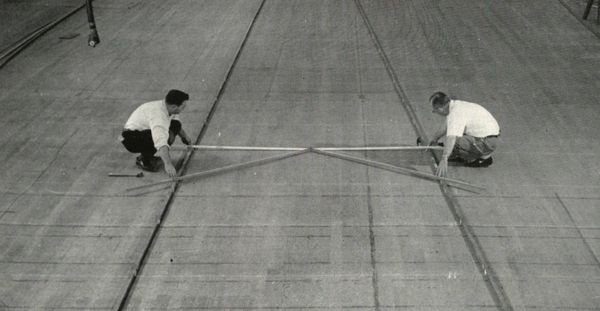
Harry A. Bulifant started his career at Newport News Shipbuilding in 1916, working in the Mold Loft. The shipyard trained him, but he continued his studies after hours, learning everything he could about how to design boats. (1) His passion led him to design and build boats for others in his backyard. In the meantime, he continued work as Assistant Foreman in the Mold Loft until his retirement in 1962. Bulifant’s day job involved measuring out hull designs on inch-thick steel plates, called shell plates, for cutting and welding together.
The difficulty lay in accurately measuring out those pieces on the hull that will be curved once cut. With a desire to curtail waste, Bulifant invented a method of laying out lines on shell plates that would align perfectly without wasting material or time. It was a simple tool called a “developer,” based on a system of triangulation. An article in Newport News’ Shipyard Bulletin praised the invention: “Naval architects and other shipbuilders have hailed Bulifant’s System as ‘a simple, practical and highly accurate solution to the 60-year-old problem of curved shell plate layout.” His System was patented, and he received recognition from the Shipyard. (2)
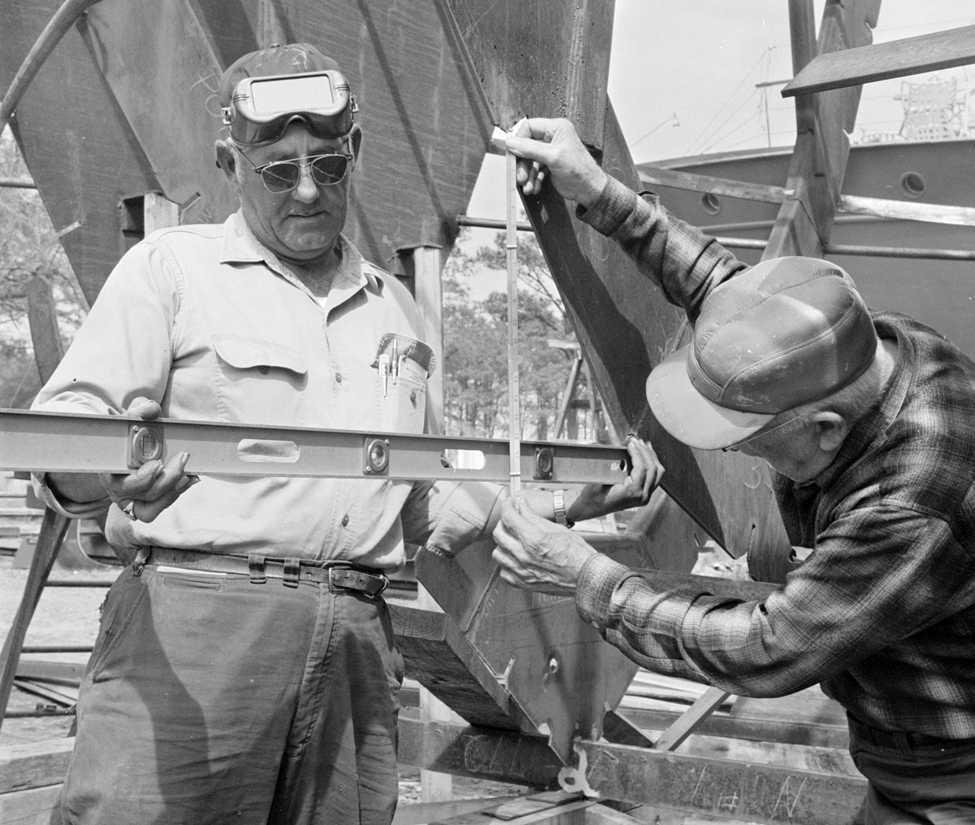
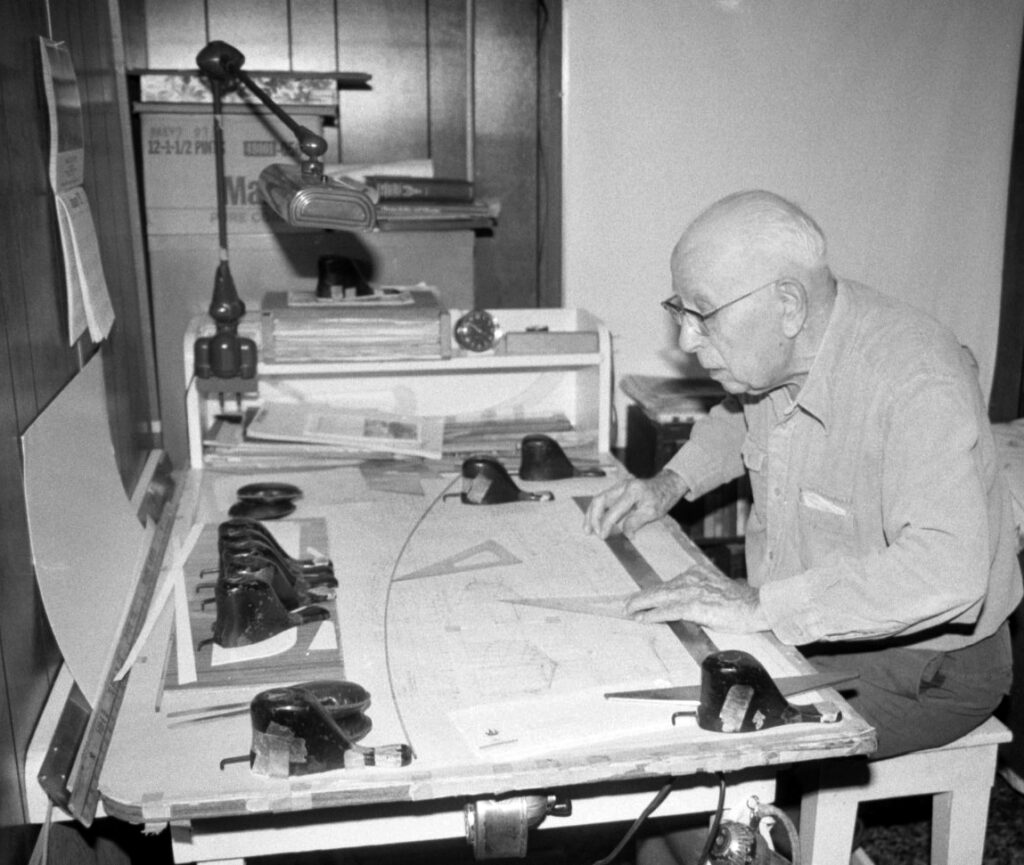
After 37 years in Newport News Shipbuilding’s Mold Loft, Harry Bulifant retired and relocated to Mathews County, where he continued designing boats for all kinds of uses. It’s no surprise then that he crossed paths with John Frye. Harry Bulifant was featured in an article and photographs by Frye in Boating magazine in 1969. About Bulifant, Frye wrote:
What is remarkable is that he has carried on his precise design and lofting work in a country where a lot of boatbuilding has been by rule of thumb and not much else. Here and in many another part of the Bay, a builder may tell a prospective client simply, ‘Show me a picture and I’ll build you the boat.’
and
(Bulifant) brings all the skills which went into his share of lofting luxury liners like the United States and the America, several President ships, freighters, colliers, and tankers, aircraft carriers, and submarines. (1)
Harry Bulifant worked with many of the boat builders in and around Deltaville, Virginia. Most of his designs were one-offs, catering to the needs of the client; however, one of his designs has endured. Bulifant’s Deltaville Garvey 26, highlighted in a 1982 feature by Larry S. Chowning, is described as “a simple, economical and durable craft designed and built to satisfy the commercial fisherman’s requirements. The sharp vee in the blunted bow flattens out in the run aft, helps push chop away from the boat, keeps spray out of the fisherman’s face and contributes to the boat’s overall seakindliness.” (3)

Bulifant had first seen a garvey in New Jersey some 60 years prior to recommending his garvey design to John H. Collamore III of Hull’s Unlimited East. Collamore was seeking a boat that could “carry a goodly amount of oysters ‒ over 100 bushels ‒ and still be used in the extremely shallow waters of the Chesapeake Bay.” (4) Collamore built the garvey and found that the design not only met his criteria, but there was room to spare.
The garvey design proved to be endlessly adaptable and found many uses, including “research vessels, dive boats and fire boats.” (4) It became a staple in the area for builders such as Larry Jennings, George Butler, and the Cockrell brothers.

In 1934-35, Harry Bulifant also worked with Vincent J. Serio, Sr. on the design of Serio’s Hampton One racing sloop, “the first of a one-design class that originated locally.” The novel design garnered international attention, and adapted designs are still popular today. Jasyto, the first Hampton One boat is now part of The Mariners’ Museum’s Collection and on display in our International Small Craft Center. (5)
Over his life-long career, Harry Bulifant designed a wide variety of vessels, from passenger ships and aircraft carriers to yachts, workboats, and recreational craft. His ability to meet the needs of watermen and industries alike attests to his creative genius. His contribution to Chesapeake Bay watercraft cannot be overstated.
We are grateful that John Frye’s negative collection has been digitized with funding from a Save America’s Treasures Grant.
Sources
1. Frye, John. “Cap’n Harry Bulifant…The Man Who Defies Parkinson’s Law.” Boating, April 1969.
2. “Bulifant Awarded Five Thousand Dollars.” Shipyard Bulletin, Newport News Shipbuilding and Dry Dock Co., November 1958.
3. Chowning, Larry S. “The Deltaville Garvey: An Economical, Versatile & Seakindly 26-foot Workboat.” Small Boat Journal, No. 25, Pgs. 58-61. Deltaville Maritime Museum. Accessed February 10, 2026. https://deltaville.pastperfectonline.com/archive/D4B86D95-55D5-4C86-A798-330926446859
4. Chowning, Larry S. “Harry Bulifant: Dean of area boat designers is 88, and still going strong.” Southside Sentinel, Vol. 88, nbr. 21, Pgs. 6, 11. Virginia Chronicle. Accessed February 19, 2026.https://www.virginiachronicle.com/?a=d&d=SSE19830526.1.26&e=——-en-20–1–txt-txIN——–
5. 1976.0016 Object file: Hampton One sailboat, 1934-1935.
Chowning, Larry S. “Tethys: A Very Special Garvey.” Small Boat Journal, No.25, Pgs. 61a. Deltaville Maritime Museum. Accessed February 10, 2026. https://deltaville.pastperfectonline.com/archive/9707C434-3ACF-4AAF-BB2A-160844268716