Welcome to the next installment in our WILD Wednesday series. Today, we’ll discuss invasive plant species in Mariners’ Park. I’m Sav Allen, the Horticulture Crew Lead on our Landscape Team. My job is to maintain the health and appearance of the cultivated garden areas around the Museum, as well as wild herbaceous plants and shrubs throughout the 550-acre Park. (Our Lake, as well as the trees in our forest, are managed by other members of our Park Team.)
I have worked in many aspects of the landscape trade, from merchandising plants at Lowe’s, to caring for container gardens throughout Busch Gardens, to everyday landscaping at home. I am a senior at Colorado State University finishing up my Bachelor’s in Horticulture Business Management, learning to fuel my passion for native plants and how we can incorporate them into our environment, prolonging the life of our forest. Before we can move forward with bringing back native plants, or even nurturing them, we have to address the invasive plant species that have begun taking over the land.
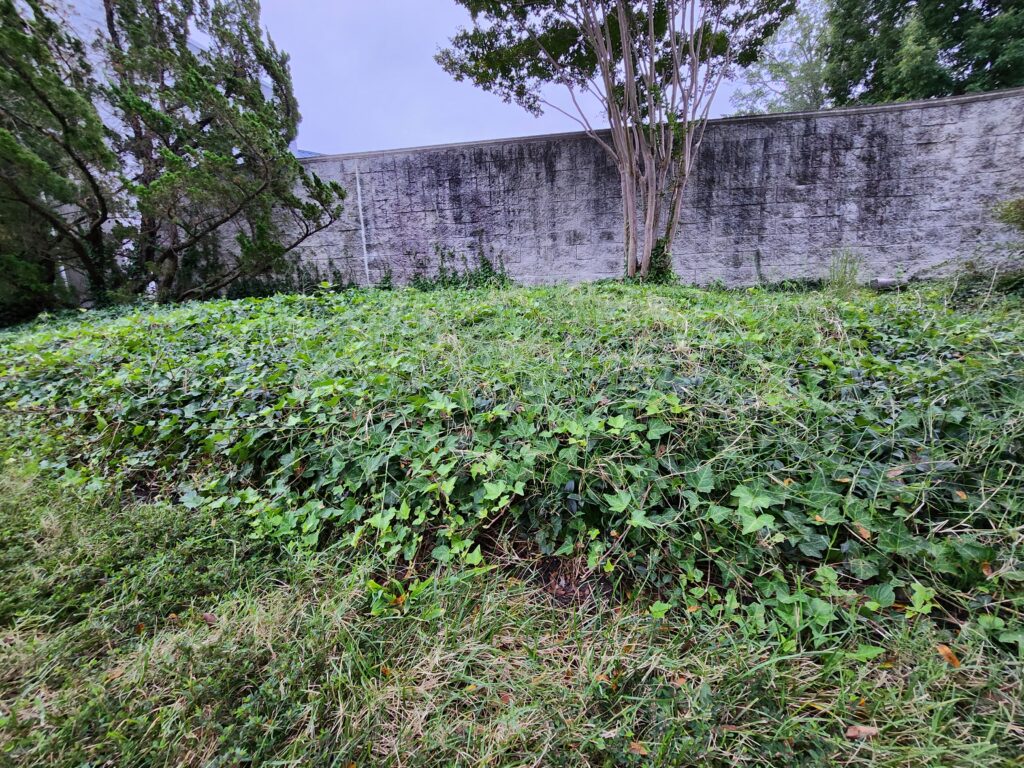
Invasive plant overview
Let’s take a step back and chat about invasive species. The term “invasive species” can seem like a broad, blanket term for any plant that we don’t want in our garden, but there is so much more to it. Our ecosystems work in a very give-and-take environment — sharing nutrients with a neighbor, absorbing carbon dioxide from a human, and providing nectar for pollinators are some very limited examples, but they all work as a circular nutrient exchange cycle. In order for this circular exchange to occur, each plant and animal in an ecosystem must have a specific purpose, or niche, that is not currently being met.
Starting this project through WILD, and continuing this work in the future, makes you look at The Mariners’ Park for exactly what it is: a fully functioning ecosystem within the bounds of a city. These urban forests are becoming extinct, and the Earth cannot afford to lose any more green space. It is essential that we begin to care for our forest in a way that is meaningful on an ecological level; this starts by clearing away the invasives that are starting to overtake.
When an invasive plant species is introduced to the ecosystem, everything gets disrupted. The invasive species does not only fill one niche; it usually fills the roles of multiple niches, while exchanging nothing. English Ivy, for example, spreads out across the forest, climbing the trees, and blocking the sun out for our native plants, and supplying no nutrients or benefits to the plants around it. In fact, it will grow and take over to the point that trees get choked out, native seed banks on the forest floor never reach germination, and other herbaceous natives slowly disappear. This blog will focus on the English Ivy in the forest, and future blogs will look at the lesser known invasive species starting to encroach on our forest.
How does your English Ivy grow?
Originally brought to North America by early settlers to give the land a feeling of “home” or to make it seem more like English villages (Taylor, 1996), English Ivy is one of the most notable invasive species on the East Coast of the United States. Though sold as an ornamental, it is notorious for breaching its confines and growing everywhere. English Ivy is a prolific grower, propagating from broken stems, leaves, rhizomatous root systems, and, of course, dropped seeds; it is made to spread, and it does this very well.
A spreading plant doesn’t always mean that it is harmful or invasive, but the way in which it spreads and a lack of natural predators to fight the spread contribute to its status as an invasive species. English Ivy roots in two ways: underground and aerial.
Rhizomes (or underground trailing roots called runners) spread through the soil, attaching themselves at each node (where a new branch or leaf forms), anchoring the plant further into the ground. By anchoring itself in all directions, it creates a mat across the forest floor, preventing growth from other plants below.
If you notice, English Ivy doesn’t produce berries while in these mats on the ground; they need more sunlight to mature to a fruiting stage, and the only way to get more sunlight is to start climbing. It isn’t picky either; it will climb anything it can attach to, like trees, fences, or poles. Once the aerial roots make contact with an upright structure, they release sap, essentially gluing themselves on, and they begin to climb. Their roots work the same as those on the ground, but instead of branching outwards, they branch up, rooting at each node as they go. Once they can reach the sunlight, they enter the fruiting stage, growing berries along the vines.
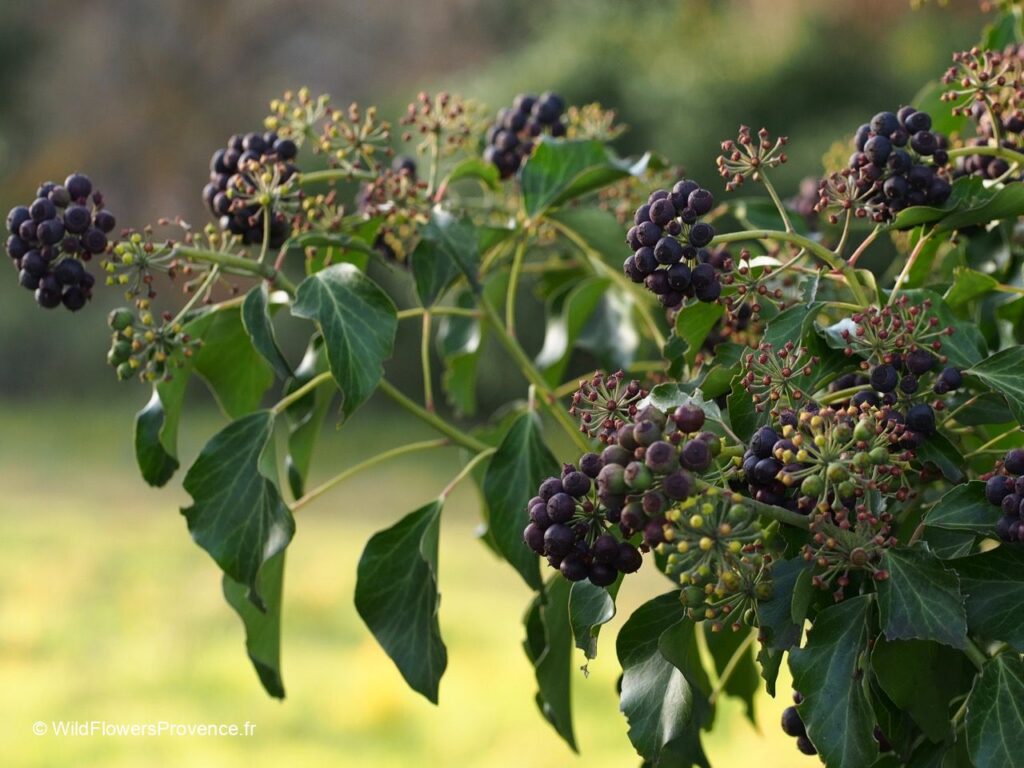
Berries are the only part of English Ivy that is eaten by native wildlife regularly, like birds and squirrels, but instead of keeping the English Ivy at bay, these animals help to further the spread by dropping seeds all over the forest. These seeds start the process of reaching and climbing all over again.
The more dense the growth becomes, the less native plants can compete for sun or nutrients; and the trees supporting the aerial growth slowly start to get choked out by the roots digging and gluing into the bark. Though it isn’t a parasite in the sense that it is directly pulling nutrients from the trees, it is a parasite in the damage it causes not only to the trees, but to the entire ecosystem around.
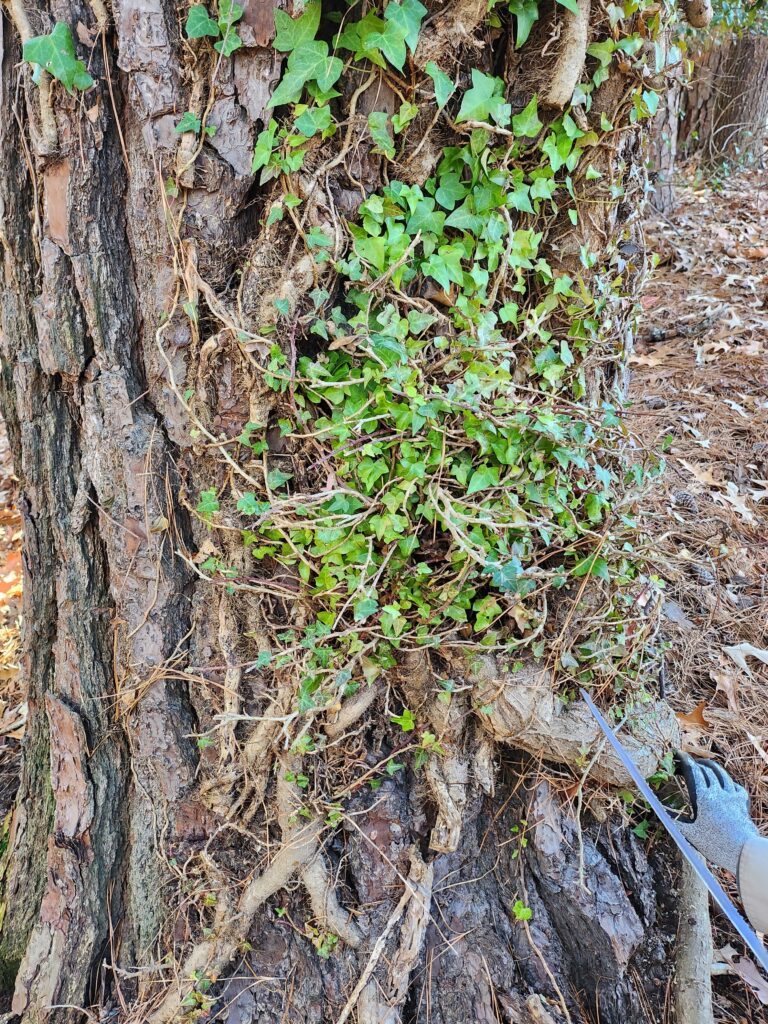
Without the weather patterns or animal predation that English Ivy faces in Britain, it has endless growing potential until humans intervene. This is where the WILD project starts, mechanically removing invasives like English Ivy from 100 acres of forest. After we pull as much as we can, we will apply a foliar herbicide to newly emerged English Ivy leaves, taking care to spray only the invasive species, or spot spraying, to reduce contamination with the native seed banks waiting below.
Native alternatives to consider
In some areas, a native alternative to these invasive species will be planted. For English Ivy, our native alternative is Virginia Creeper (Parthenocissus quinquefolia), a fast-growing native vine that spreads up and out, without harming the plants around. Unlike the aerial roots of English Ivy, Virginia Creeper aerial roots end in a branched formation, with small adhesive pads that attach to the trees. This gives the Virginia Creeper the support it needs to reach the sunlight, without causing damage by penetrating the bark.
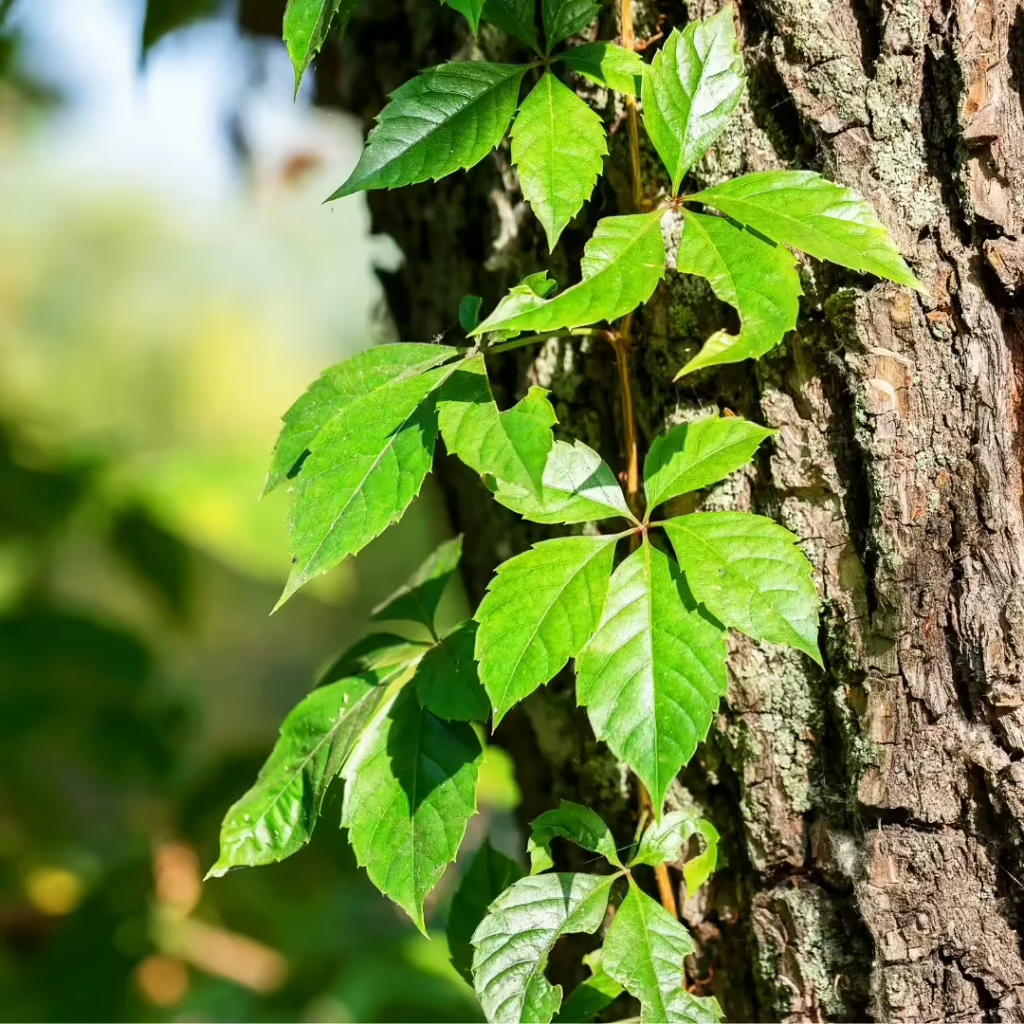
The leaves, stems, roots, and berries are used as a food source for deer, small mammals, and birds, contributing to the nutrient cycle in the way a native plant should. Not only can it be recycled into the nutrient system via animals, Virginia Creeper is also deciduous, allowing its leaves to fall and decay in winter, adding to the nutrients on the forest floor. This is the biggest difference between an invasive species and a native species, because Creeper has evolved alongside the other species in our forest, it has a niche job that allows it to grow and thrive, while contributing to the overall health of the forest’s ecosystem. Right now, English Ivy has taken over the job of Virginia Creeper, in an unhealthy and useless way.
As we work to mitigate the English Ivy, natives like Virginia Creeper should return on their own, but we will help them along by spreading seeds. Removing invasive species is the first step in our journey towards a healthier urban forest, but it is by far the most important.
Join me next time as we discuss our next invasive species, Periwinkle (Vinca minor/major).
*This project was made possible by the National Fish and Wildlife Foundation WILD grant.
Sources:
- Natives, V. (2019). Plant Virginia Natives. Plant Virginia Natives. https://www.plantvirginianatives.org/plant-southeast-virginia-natives
- Parthenocissus quinquefolia (Virginia Creeper, Virginia-creeper, Woodbine) | North Carolina Extension Gardener Plant Toolbox. (n.d.). Plants.ces.ncsu.edu. https://plants.ces.ncsu.edu/plants/parthenocissus-quinquefolia/
- Waggy, M. (2010). Hedera helix. Www.fs.usda.gov. https://www.fs.usda.gov/database/feis/plants/vine/hedhel/all.html
Taylor, R. L. (1996). Plants of colonial days. Dover Publications.