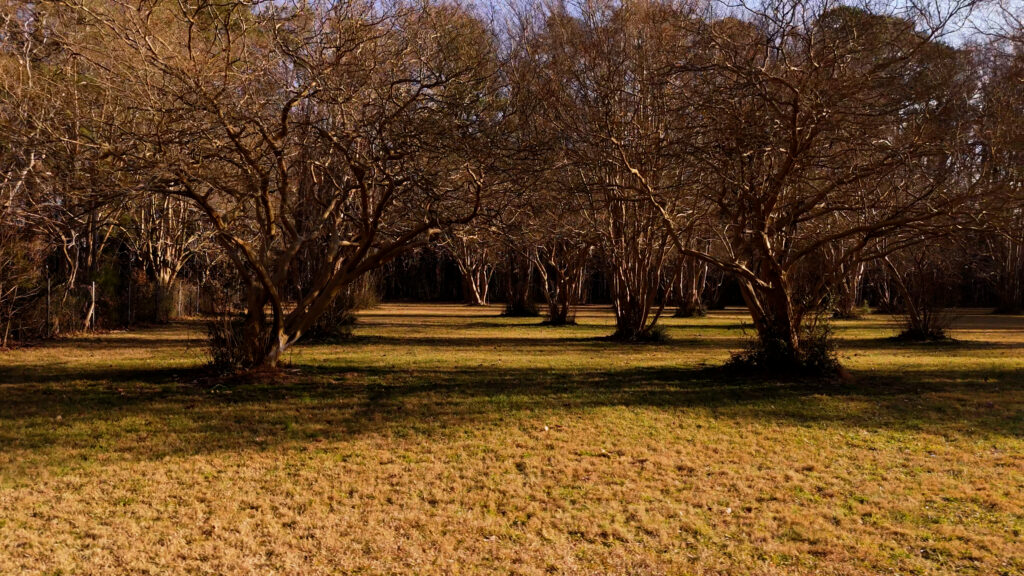
If you have ever walked past, or even driven past, the Mariners’ Museum and Park during the spring or summer months, you have surely seen the crapemyrtle trees that line Avenue of the Arts, bursting with colorful flowers. In fact, you can see them driving around most of the Hampton Roads area, lining the interstate, planted at your favorite shopping center, or even closer — your neighborhood streets or your own home. So what’s their story?
Crapemyrtles (Lagerstroemia spp.) were introduced to the United States in the 1790s in Charleston, South Carolina. (1) A botanist had them imported from parts of Southeast Asia to test their viability as an ornamental plant in the United States. They were a quick success. Not only did they look bright and attractive throughout the seasons, but they could handle the environmental patterns of Virginia’s east coast. So when preparing plans for a park in the heart of Newport News, or Warwick County, it comes as no surprise that crapemyrtle is on the purchase list of ornamental species (see figure 1).
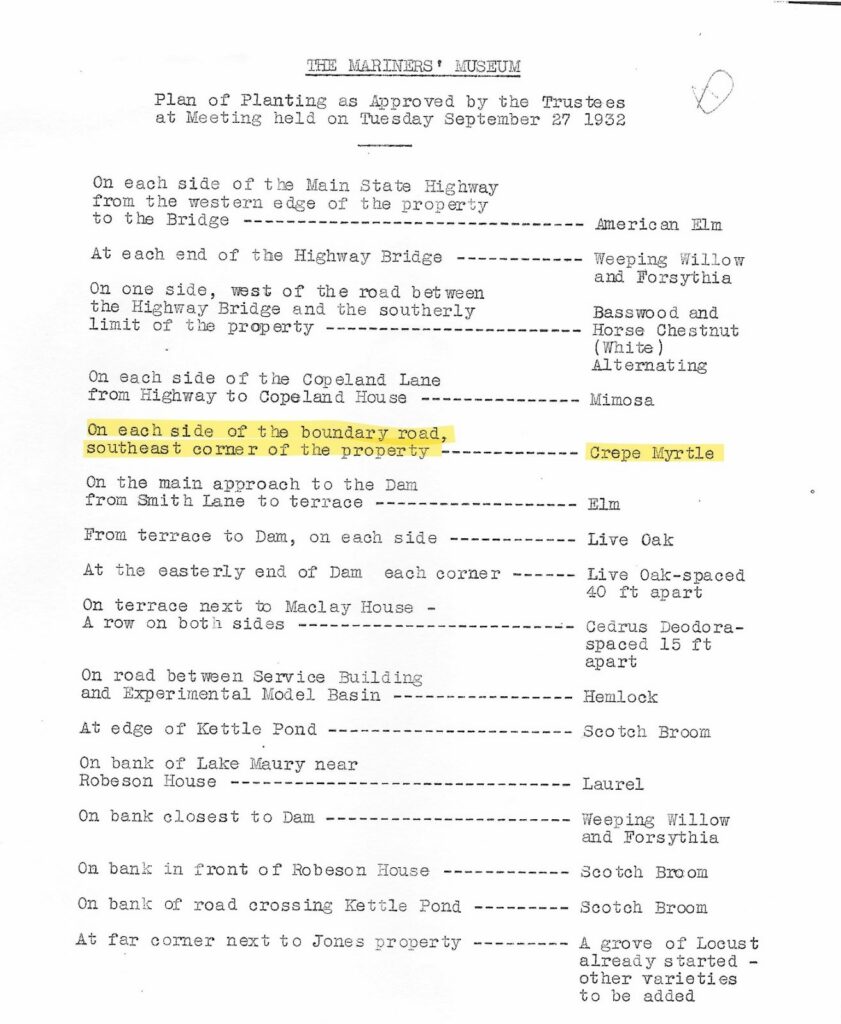
At the time, the only plan for crapemyrtles was a row lining Boundary Road with other species of trees planted around the Park. If you have visited the Park since then, you can see that the number of crapemyrtles on the property has grown significantly, including the major stand in Copeland Field. Not only were more planted, but they are notorious for their ability to propagate and expand their stand with little to no human interaction.
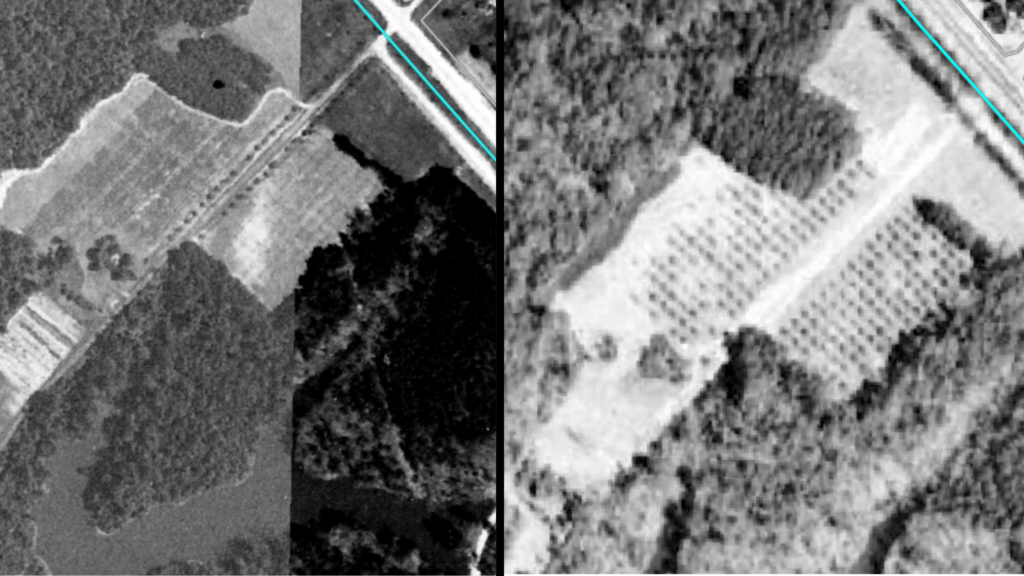
Crapemyrtles propagate through seed and asexual reproduction, also known as the “suckers” or “water sprouts” that pop up from around the trunk. This would seem like the ideal outcome from planting a tree that is so enjoyed, but we have learned a lot more about our environment since then, and the unhealthy impact some invasive species have.
We know now that crapemyrtles offer very little to the ecosystem in Mariners’ Park, and for an ecosystem to continue to move and thrive, everyone has to play their part in the nutrient and water cycle. To do this, the crapemyrtle would need to be able to feed, house, and offer protection to wildlife, all while sustaining the nutrients in the soil and aiding the growth of their fellow plants and animals around it.
This is something a crapemyrtle simply cannot do here. In this type of environment, though the crapemyrtle can grow, it also attracts some very unwelcome pests and diseases that will transfer to our native species. Two prominent examples we have and still see in the Park are Powdery Mildew (Erysiphaceae) and Crapemyrtle Bark Scale (Acanthococcus lagerstroemiae). Powdery Mildew is something we see often because of the high humidity and our proximity to the water, but Crapemyrtle Bark Scale is not something native to this region, meaning this pest has a limited number of predators that can keep it controlled, unlike a native alternative.
When native plants evolve over time within an area, alongside the animals, there becomes an equal distribution of “jobs” in the environment, or niches. Each plant and animal within an area provides a function that aids the environment around it, like providing nectar earlier than in any other environment to sustain early emerging bees that have grown accustomed to the nectar in this carefully crafted ecosystem. Not crafted by us as humans, but by the intricate weaving of evolution to sustain the plants and animals in this environment. Native plants have evolved over time to provide the nutrients to the soil that their neighbors are using, or the seed birds rely on when the spring weather is still a bit chilly; this is the benefit of using a native plant. They have the unique ability to thrive and look pleasing, all while contributing to the nutrient cycle needed to continue sustaining life in the Park. As we try to continue amending and nurturing this Park, big but necessary changes are starting to take place.
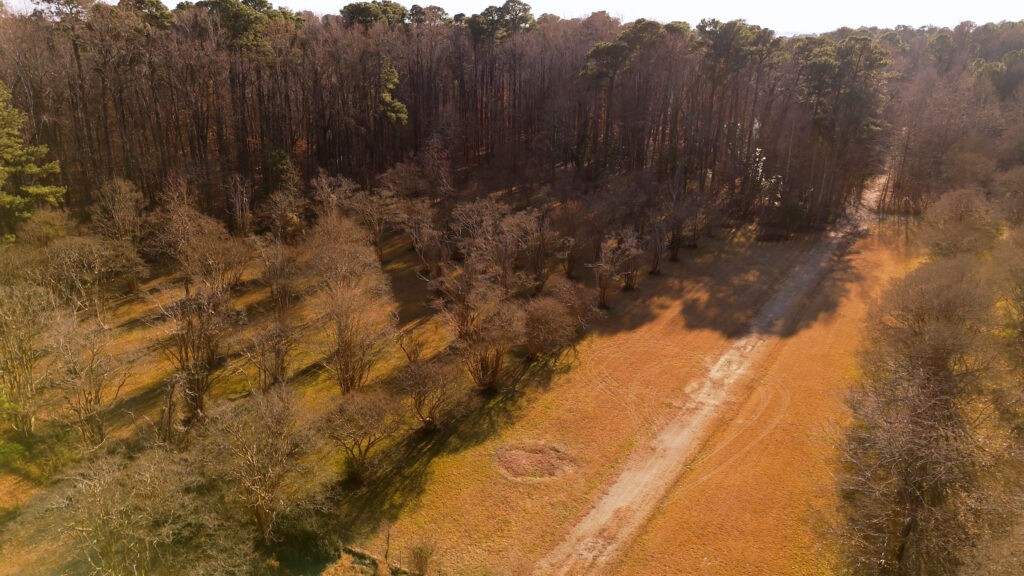
Our Park sits on such a large watershed that it is important to reassess the plants that were brought on property as ornamentals, and wholeheartedly focus on bringing in plants that feed and nurture our unique environment. This includes bringing back more of the native plants that have been lost over the many years of change this land has seen. The native plants in our area have grown and evolved alongside our fauna, and act as hosts to the butterfly and moth larva, offering a home and food as they mature.
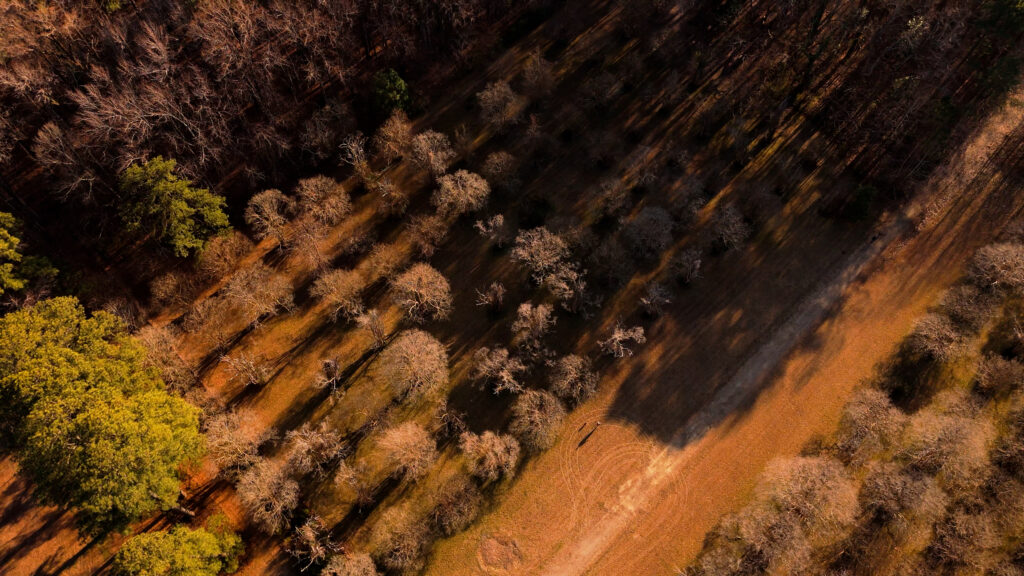
That is why you will see crapemyrtles being cut down in Copeland Field now and in the near future; to make way for a meadow made entirely of native plants. Similar in style to the meadow that was started in 2025 in Williams’ Field off of Boundary Road. The plan is to clear the trees in sections and plant meadow space in their place.
With a robust community of native species, we are able to cater to the many species of animals that have already found a home in the Park or are looking for a safe space to call home. A meadow provides shelter and food for deer and insects like seed, grass, and nectar, or a safe place for a fawn to rest out of sight. Not only will the wildlife benefit from this transition, but the land itself will benefit. The deep roots of native plants act as a buffer, or filter, from runoff entering the Lake by absorbing excess nutrients and phosphorus from the runoff before it can leach into the soil or even deeper, natural ground water stores.
These roots also work to prevent the soil itself from becoming part of the runoff that enters the Lake, by holding the soil firmly in place. They are one of our biggest defenses against erosion. The benefits and diversity of the species of plants in the meadow will allow many different species of animals to thrive. Grasses planted in the meadow are also great at carbon sequestration, as they pull carbon from the atmosphere and store it deep in the soil (these roots can grow upwards of 8 ft. in depth). Not only are they fantastic at pulling carbon from the atmosphere, but meadows are also an excellent source of oxygen production, even better than the crapemyrtle stand. (2)
These are just a few examples of the benefits this transition will bring to the Park, and to Newport News as a whole. As the meadow grows, walking paths will be available so guests can enjoy the native flora and fauna up close. We in the Park Department, and especially the Horticulture Team, hope you are as excited as we are to embark on this journey of nurturing the land and honoring our Park’s history of creating a serene place for “connecting visitors with nature and maritime history through a curated landscape (Archer Huntington).”
Sources:
- Save the Crepes! | Charleston Magazine. (2016, January 13). CHARLESTON SC |. https://charlestonmag.com/features/save_the_crepes
- Why Organic Lawns, Montgomery County, MD Government. (2025). Montgomerycountymd.gov. https://www.montgomerycountymd.gov/DEP/property-care/lawns/homeowner/why-organic.html
- Crapemyrtle Bark Scale. (2021). Vt.edu. https://www.pubs.ext.vt.edu/ENTO/ento-465/ento-465.html