A few months ago, I wrote the first part of a two-part Hidden Histories series. The first blog, subtitled “Portraits of a City”, highlighted five images from the Ellis Parker Griffith Collection, housed at The Mariners’ Museum and Park. This blog is the second part of the two-part series and features images from the Museum’s Hampton Roads Port of Embarkation (HRPE) Collection, along with the stories behind each image and the mysteries that remain. Each image reveals how Newport News played a vital role in the vast effort that ultimately led to the victory in World War II.
Hampton Roads Port of Embarkation
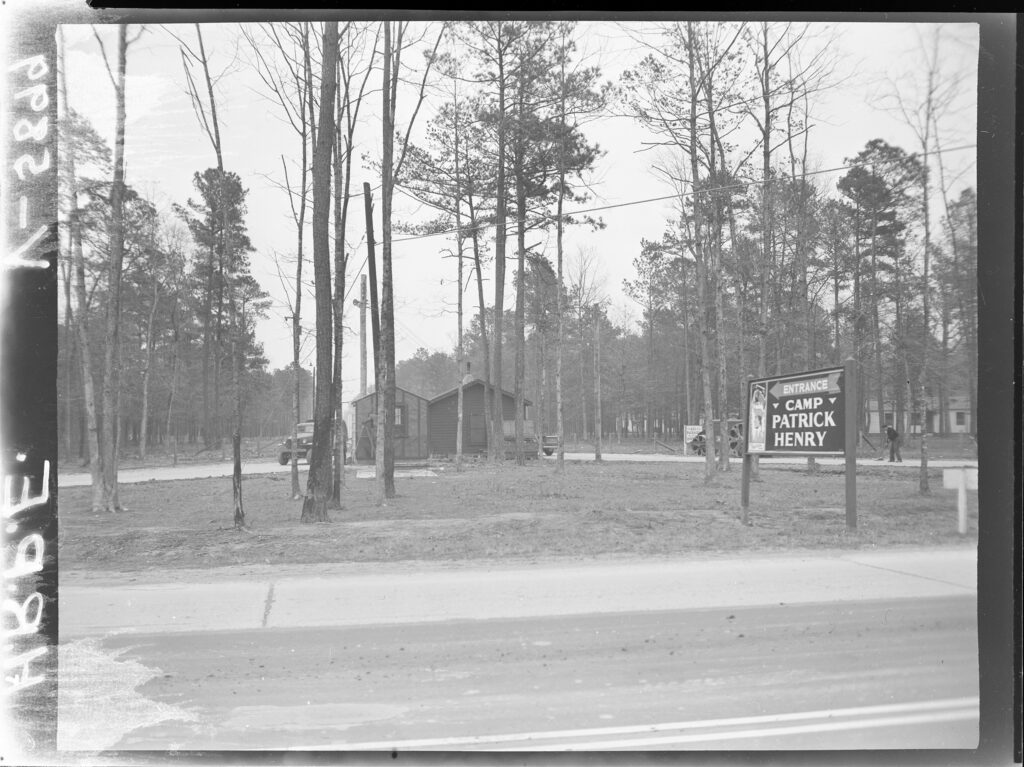
Hampton Roads was a significant port for transporting supplies and personnel to various theaters during World War II. According to the historical marker located at West Ave. and 25th Street, 1.687 million people passed through HRPE between June 1942 and September 1945. To learn more, visit the other blogs on our website related to HRPE. Two of the images showcased in this blog were taken at Camp Patrick Henry. Camp Patrick Henry was in what is now the Denbigh area of Newport News, near the current site of the Newport News/Williamsburg International Airport. Camp Patrick Henry served as a staging area for troops and personnel going overseas.
He Saved the Bank
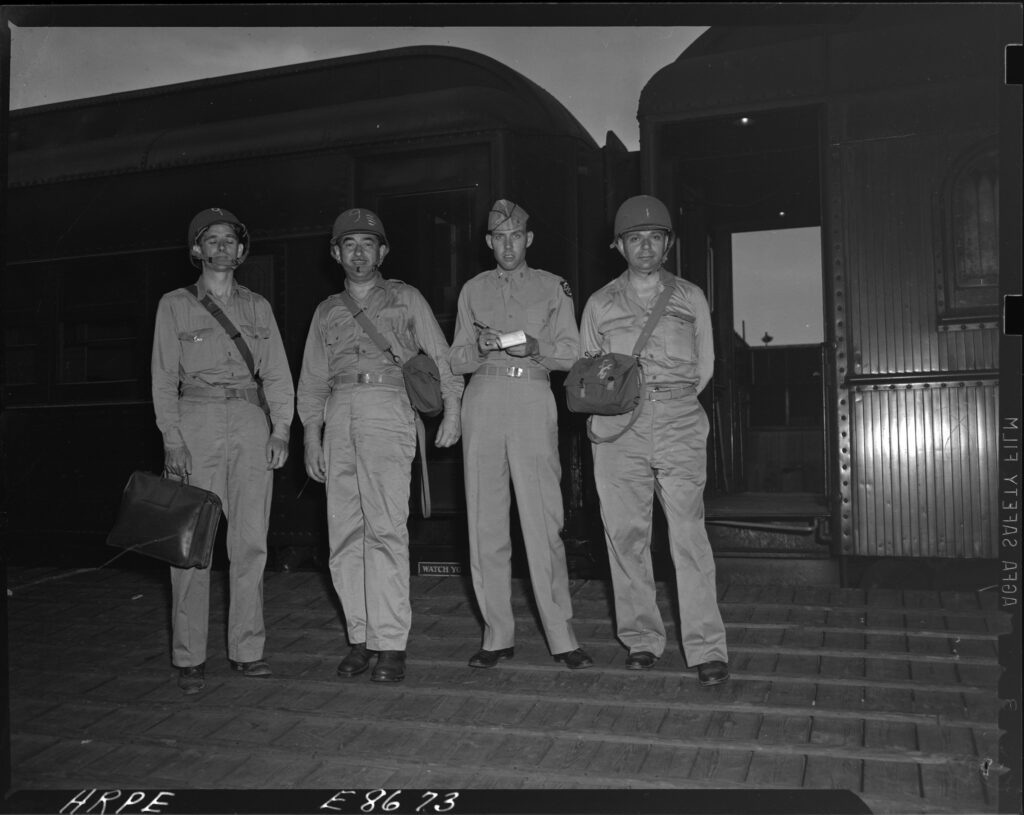
Among the many personnel that came through Hampton Roads were officers of the Office of Strategic Services (OSS), the first organized effort by the United States to implement a centralized system of strategic intelligence. Led by General William Donovan, the “Glorious Amateurs” (as Donovan called them) were involved in every theater of the war from Europe to Asia. Although their stories were previously hidden due to national security concerns, some are now being told. One of the stories is that of Irving H. Sherman.
Sherman was born and raised in New York. After graduating from Cornell University, he worked for A. G. Becker & Co., an investment firm out of New York, in the sales department. Sherman’s work would take him to pre-World War II Europe, where he assisted in Becker investments and opened Becker’s Berlin office in 1929. He left Berlin in 1939.
After returning to the United States, Sherman was recruited by General Donovan due to his activities in Berlin and his knowledge of the German financial situation. Sherman worked in Bern, Switzerland, under Allen Dulles, the first director of the Central Intelligence Agency. As the war was ending, Sherman embedded himself with a US Army unit that went into Berlin. Senior management of the Berliner Handelsgesellschaft Bank contacted Sherman, whom they had known from his time in Berlin, regarding their concern about the Soviets pillaging the gold in the bank’s vault. Sherman arranged for an Army caravan to go to the bank to retrieve the gold and take it to an undisclosed location west of Berlin. When the war ended, the bank retrieved its gold and was able to restart operations.
Sherman exemplified the caliber of an individual who passed through the HRPE. His actions helped the German banking system recover after the war. When he returned to Europe in 1967, the bank honored him like royalty, recalling how Irv Sherman had saved their bank.
Different Paths, Shared Purpose
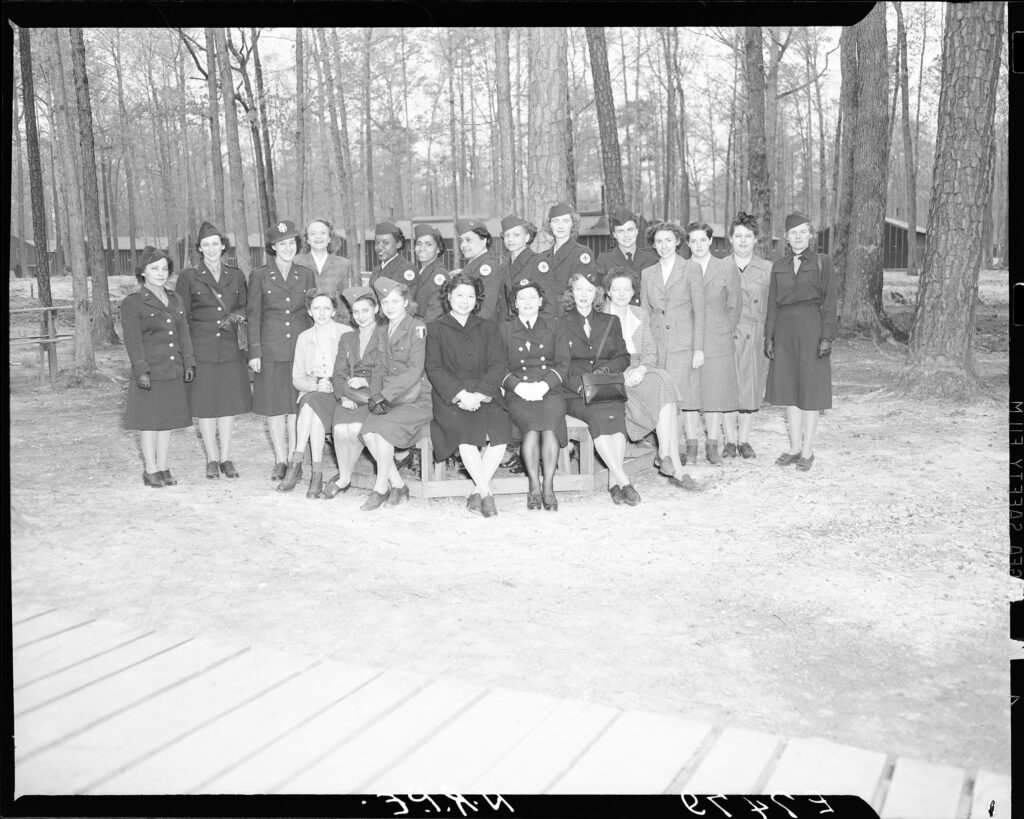
This image caught my attention when I came across it in our online catalog. First, it is a cross-section of women supporting the war effort representing the United States, the American Red Cross, Canada, Free France, and China. Second, the title of the image, “Foreign Economic Administration,” was unfamiliar to me. Research revealed that the Foreign Economic Administration was responsible for wartime functions, including export control, foreign procurement, lend-lease, reverse lend-lease, participation in foreign relief and rehabilitation, and economic warfare (encompassing foreign economic intelligence). Finally, the HRPE photographers left the women’s names. Although the list of names does not specify who is who, is not in any order, and some names are misspelled, it did provide a starting point to uncover each woman’s story.
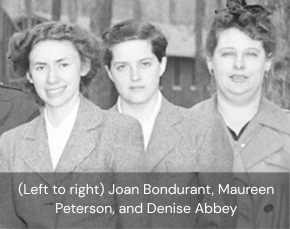
One of the first stories I found was that of Denise Abbey, who served with the Office of War Information. The mission of the Office of War Information was to formulate and execute information programs that promoted, in the US and abroad, an understanding of the status and progress of the war effort, as well as the war policies, activities, and aims of the US government. One of the first stories I found was that of Denise Abbey, who served with the Office of War Information.
Abbey sat for an oral history interview in 1988, conducted by The Association for Diplomatic Studies and Training. Her oral history gave insight into one transport route and her wartime service. According to Abbey’s oral history, she arrived at Camp Patrick Henry on April 19. However, she had to wait two weeks for enough women to come for their transport across the Atlantic on the General Mann. The trip took nine days from HRPE to Oran in Algeria. After staying in Algeria for two weeks working with John Albert, Abbey traveled to Naples, Italy.
While some women, like Abbey, went to Europe, others went to a lesser-known theater: the China-Burma-India (CBI) theater. The China-Burma-India theater is often considered a forgotten theater of World War II, mainly due to the historical emphasis on the European and Pacific theaters. The CBI theater opened in March 1942 to transport supplies to the Chinese Central government forces who were fighting the Japanese.
Two of the women who went to the CBI theater were Joan Bondurant and Maureen Peterson. Bondurant and Peterson (to the left of Denise Abbey) were officers of the Office of Strategic Services. As mentioned earlier, it was the first organized effort by the United States to establish a centralized system of strategic intelligence. When they initially arrived in India, Bondurant and Peterson’s espionage efforts focused on the Japanese before shifting their focus to the Indian independence movement. After the War, Bondurant returned to India, where she met Mahatma Gandhi, whose life she described as “proof that the final power lies in good.”
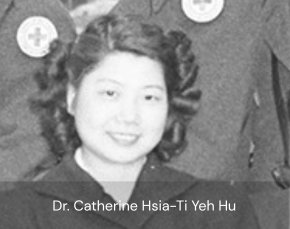
Another story I found is that of Dr. Catherine Hsia-Ti Yeh Hu. I learned about Dr. Hu’s story by speaking with her grandson, Victor, and through an online copy of Ten Thousand Scrolls of Books, translated by Dr. Esther Hu of Boston University. Dr. Catherine Hsia-Ti Yeh Hu was born in Songyang, Zhejiang Province, China. Dr. Hu came to the United States from China after graduating from Guanghua University amid the Second Sino-Japanese War in 1937 (which eventually coincided with World War II).
She arrived in the United States aboard the President Cleveland, one of two sister ships (the President Coolidge was the other) built by Newport News Shipbuilding for Dollar Steamship Lines, which eventually became the American President Line. She continued her education at The George Washington University before matriculating at the University of Wisconsin-Madison, where she earned a Ph.D. After returning to China, Dr. Hu married Nationalist General Hu Zongnan
Dr. Hu’s story highlights the vital role that Newport News has played on the world stage. Newport News built ships that carried people across the seas and served as a gateway for travelers heading abroad. As the steward of Newport News Shipbuilding’s history, The Mariners’ Museum and Park preserves this connection and many other connections through ship models, such as President Cleveland in our Defending the Seas gallery, and archival pictures of her in our catalog. Through Dr. Hu’s journey, we are reminded that our stewardship extends not only to Newport News Shipbuilding’s history but also to the family stories that give these vessels enduring meaning.
Harbor Nights
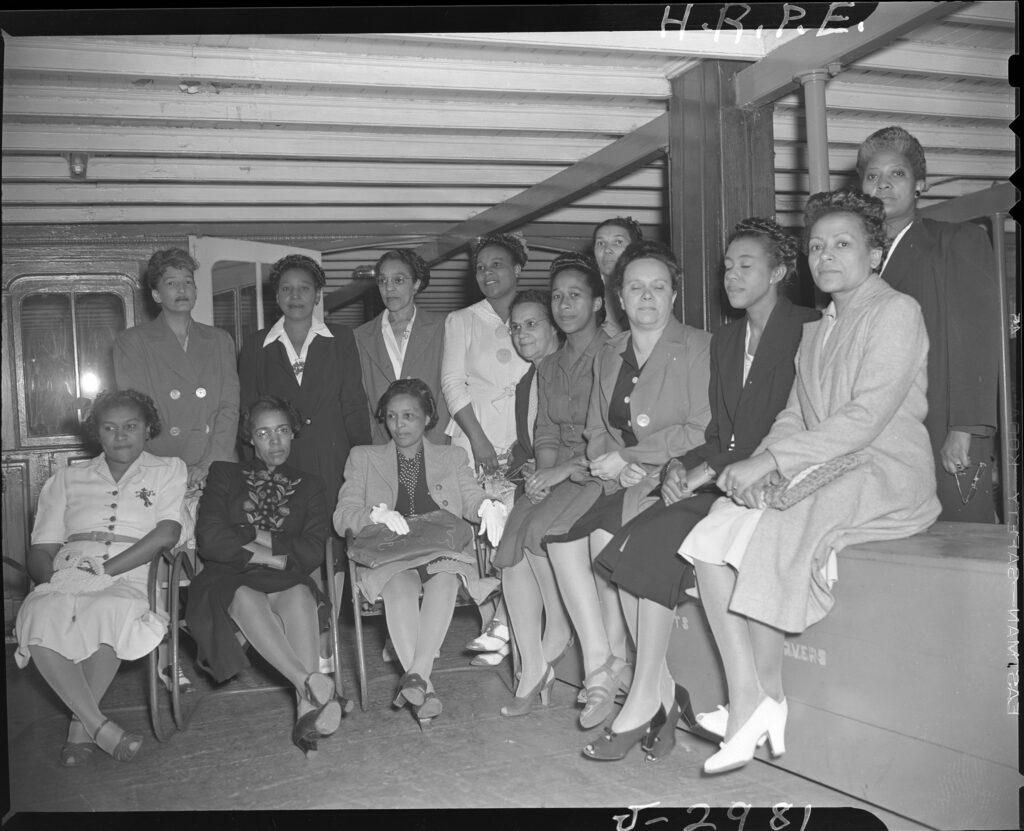
In the last entry, I highlighted the China-Burma-India theater as a forgotten theater overshadowed by the European and Pacific Theaters. There is another theater outside of the previously mentioned three: the American Theater. The American Theater consisted of areas surrounding and including the American homeland. The men who served at the HRPE are considered to have served in the American Theater.
The information accompanying the photo above stated that it was taken during a boat ride aboard SS Mohawk for the 785th Sanitary Company and their guests. Providing entertainment and recreation for the soldiers was not uncommon. We have numerous pictures of the games and dances held at the HRPE. To determine if any articles have been written about boat rides on SS Mohawk, I researched the newspapers. I found an article in The Journal and Guide dated July 17, 1943.
The article mentioned that the men of the 277th from Camp Hill were entertained aboard US Mohawk with a boat ride (Journal and Guide, Saturday, July 17, 1943, page 3). Although this boat ride occurred a few weeks after the one where this picture was taken, it allows me to conclude that USS Mohawk was used to provide boat rides to the soldiers.
Along with telling of the event, the photographer also wrote the names of the women in the photograph. Unfortunately, only their last names were written. When I looked at the names, I saw one that stood out: Mrs. Kittrell. I wondered if Mrs. Kittrell was Dr. Flemmie Kittrell, who has a building named after her on Hampton University’s campus. As I researched the name, I soon discovered that it was indeed Dr. Flemmie Kittrell. Dr. Kittrell (second from the left, seated with her arms folded in a dark dress) was the dean of women at Hampton Institute (now Hampton University) at the time of the picture.
Dr. Kittrell, an alumnus of Hampton Institute, was the first African American woman to receive a Ph.D. in nutrition (Cornell, 1936). She returned to Hampton to teach nutrition and ultimately became head of the home economics department. She left Hampton to take a position at Howard University in Washington, DC. While at Howard, Dr. Kitrell travelled the world studying nutrition and created a model for preschool studies which served as the foundation of what became Head Start.
While I recognized Dr. Kittrell’s name, I did not recognize the other names. To identify the other women, I returned to the Norfolk Journal and Guide article for more information. In the July 17, 1943, article, it mentions that there were hostesses on the boat ride. There were a few last names in the article that resembled the last names listed on the image. When I searched for the names, I found numerous articles in the Journal and Guide that mentioned the name I was searching for. The repetition of names in multiple articles shows they moved in the same social circles.
One of the women I was able to identify, Rachel Watkins Cole, was listed in numerous articles in the Journal and Guide and The Daily Press. Rachel Watkins Coles graduated from Huntington High School in 1926. She was a classmate of Lawrence Palmer, featured in the YMCA basketball photo in the Hidden Histories: Portraits of a City blog, and Arquilla Bradshaw (seated to the left of Dr. Kittrell at the end).
Mrs. Cole then attended Virginia Union and eventually graduated from Morgan State College (now Morgan State University) in 1933. Cole was a member of First Church (Baptist) of Newport News and the Beacon Light Club (Naomi B. Urquhart, second to the right in the dark dress with her eyes closed, was also a member), the Belle Vies Bridge Club, and a charter member of the Alpha Beta Zeta chapter of Zeta Phi Beta Sorority, Inc.
How You Can Help!
The pictures presented here, as well as those in the first blog, are just the tip of the iceberg. Our catalog features numerous images taken by Ellis Parker Griffith and the photographers of the Hampton Roads Port of Embarkation, whose stories remain unknown. Where our research ends, your help begins. If you recognize anyone in these images or in our online catalog, please don’t hesitate to contact me at [email protected] or 757-591-7747. By helping us identify those in the photos, you become part of the shared stewardship of memory that defines The Mariners Museum and Park.