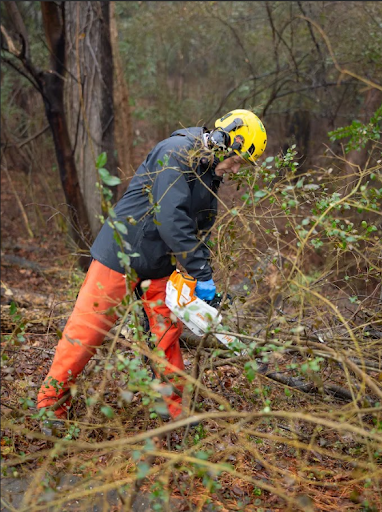
Yaupon holly, or Ilex vomitoria, is a shrub the Mariners’ Park Team will be using to replant Chesapeake WILD sites in Mariners’ Park. Chesapeake WILD, or Watershed Investments for Landscape Defense, is a grant program administered by the U.S. Fish and Wildlife Service that supports projects to conserve, steward, and enhance fish and wildlife habitats and related conservation values in the watershed.1 The grant is funding Mariners’ work to remove invasive species, plant native species, and educate on how watersheds work.
Yaupon will be planted as a native replacement for the invasive shrub Chinese privet, or Ligustrum sinense, which we are removing by the dumpster load from grant sites in Mariners’ Park. Chinese privet is a major invasive species in the southeastern United States, crowding out native species to the detriment of native plants and wildlife.2 Yaupon holly provides cover and food for birds, while also providing pollen for insects. It is also a host plant for the Henry’s elfin butterfly, or Callophrys henrici.3
While yaupon appears commonly in Mariners’ Forest today, its historical presence is murky. Our best historical botanical record of Mariners’ Park is from George C. Mason, the Park’s first forester. He collected 292 botanical specimens in Mariners’ Park from 1932 to 1935, creating a collection that is today housed at the William & Mary Herbarium.4 Unfortunately, he did not collect any specimens of yaupon holly, so we do not know for sure if they were present in the Park in the 1930s. The Mariners’ Digital Services Team captured high-resolution photographs of most of the specimens Mason collected as part of a recent collaboration with the Herbarium. They are a joy to look through and are available online through the SERNEC, Southeast Regional Network of Expertise and Collections, portal.5
Identification of yaupon holly
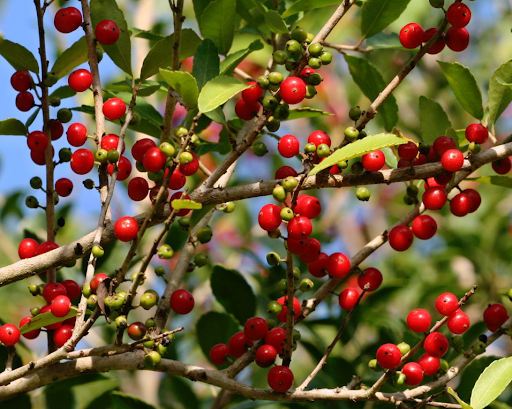
Yaupon holly takes the form of a shrub or small tree and has leaves that are alternate, meaning that they are not opposite to each other on the stem, but rather alternate from one side to the other. The leaves are evergreen and oval to ovate, ovate meaning egg-shaped. They are also fairly small, ½ to 1-½” long and ¼” to ¾” wide. Its fruits are translucent, ¼” diameter, scarlet red drupes borne on females. Michael A. Dirr, a behemoth of American woody plant botany, describes the fruits as, “truly beautiful”.6 Yaupon holly is also easy to confuse with Japanese holly, or Ilex crenata, because the plants have a similar form and the crenate teeth of the Japanese holly leaves resemble the shallow teeth of the yaupon holly leaves. The growing tips on yaupon holly tend to have a purple hue versus the bright green growing tips of the Japanese holly.
Human use of yaupon holly
I’ve discussed why we are planting yaupon and how to identify it, but you may be wondering: What does yaupon have to do with an American buzz from the title of this blog? Yaupon is one of two plants native to North America with an appreciable amount of caffeine and theobromine, both stimulants.7
Yaupon has traditionally been parched and brewed into a hospitality and ceremonial drink by Native Americans in the Southeast that European colonists called black drink. David Taitt visited widely among the Upper and Lower Creeks in southeastern North America during 1772 at the behest of the superintendent of Indian Affairs, John Stuart.8
“On the first morning of his visit to a particular town, he usually was offered tobacco and black drink in the town square. On subsequent visits during his stay, he would usually resort to the square or to the council house, depending on the weather and season, for tobacco and black drink. Taitt’s journal indicates that the leading men and chiefs of the town were generally in the square or council house in the morning and that black drink was taken before breakfast or before any discussions. On several occasions, when Taitt wanted a more formal discussion, he mentions the black drink ceremony in the evening, often for the second time within one day”.9
Yaupon was clearly a significant fixture in the culture of the Creeks, similar to how coffee is so important to modern American culture. Why yaupon fell out of favor as a stimulating drink is an interesting story that is, unfortunately, beyond the scope of this blog.
Addressing the name
The keen-eyed among you will have noticed something a little disturbing about yaupon holly, specifically its scientific name, Ilex vomitoria. You might be thinking, “Yuck! Vomitoria? I thought you said that people drank this as a stimulant?” The answer is quite simple. Ilex vomitoria is a textbook example of a misnomer. Modern chemical analysis has demonstrated that it has no emetic properties, and companies today sell yaupon tea.10 Its scientific naming by Scottish botanist William Aiton was likely due to reports of Native Americans using yaupon in a brew during purification rituals.
Next time you’re out walking in the Park, take a closer look at those evergreen shrubs, and you might just find a yaupon holly!
*This project was made possible by the National Fish and Wildlife Foundation WILD grant.
Sources:
- Chesapeake WILD Program. https://www.fws.gov/service/chesapeake-wild-program
- Hanula, J.L, Horn, S., Taylor, J.W. (2009). Chinese Privet (Ligustrum sinense) Removal and its Effect on Native Plant Communities of Riparian Forests. Invasive Plant Science and Management 2:292-300. doi:10.1614/IPSM-09-028.1
- Ilex vomitoria. Ladybird Johnson Wildflower Center. https://www.wildflower.org/plants/result.php?id_plant=ilvo
- William and Mary Herbarium (WILLI). 2026. https://www.wm.edu/as/biology/about/facilities/herbarium/
- Southeast Regional Network of Expertise and Collections (SERNEC). https://sernecportal.org/portal/index.php
- Dirr, M. A. (2010). Manual of woody landscape plants: Their identification, ornamental characteristics, culture, propagation and uses. Stipes. pp 545.
- Edwards, Adam L.; Bennett, Bradley C. (June 2005). “Diversity of Methylxanthine Content in Ilex cassine L. and Ilex vomitoria Ait.: Assessing Sources of the North American Stimulant Cassina”. Economic Botany. 59 (3): 277. doi:10.1663/0013-0001(2005)059[0275:DOMCII]2.0.CO;2. ISSN 0013-0001.
- Hudson, Charles M. (2004). Black Drink: A Native American Tea. University of Georgia Press. pp 125-126
- David Taitt, “David Taitt’s Journal of a Journey Through the Creek Country, 1772,” in Travels in the American Colonies, ed. Newton D. Mereness (New York: MacMillan Co., 1916), pp. 493-565.
- National Resources Conservation Service Plant Guide: Yaupon. https://www.nrcs.usda.gov/plantmaterials/etpmcpg13460.pdf