Hey there! My name is Mitchell Lugar, and I was a conservation intern at The Mariners’ Museum and Park during the summer of 2026! I am currently a rising senior at Hampton Roads Academy in Newport News. At HRA I’ve taken a course load aligned with environmental studies, which has become a passion of mine. Caring for the environment, especially our water, ranks at the top of my to-do list. During my internship, I was able to broaden my horizons by learning more about water quality and how waterways are affected by our everyday lives. Along with environmental conservation, experimenting with 20th-century film negatives gave me insight into the heritage conservation side of the museum.
Why Water Quality?
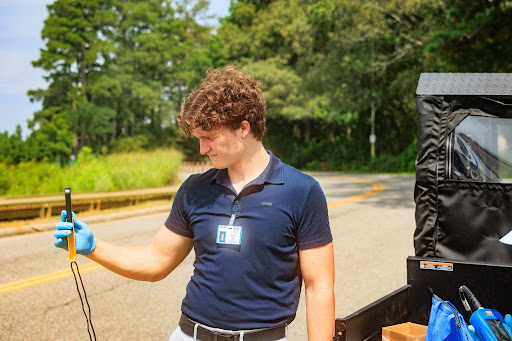
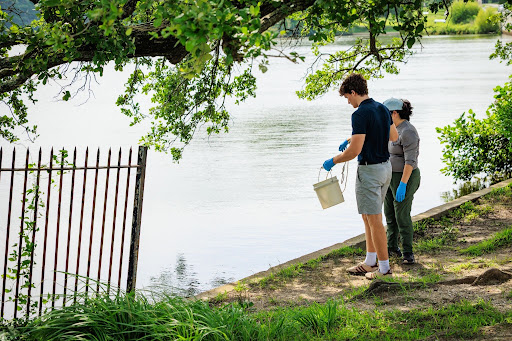
The Mariners’ Museum and Park gave me the opportunity to expand my knowledge about the health of The Mariners’ Lake and Kettle Pond through analysis of ten total samples from these bodies of water. The analysis involved measurements of anion concentration using anion chromatography in the lab, and a series of on-site measurements using the HydroLab HL7 Sonde. The HL7 is a multiparameter data sonde equipped with sensors for water temperature, conductivity, salinity, pH, luminescent dissolved oxygen (LDO), turbidity, chlorophyll-a, and total dissolved solids (TDS). The data collected allows us to determine if a site is affected by relatively high amounts of chloride (salts and industrial effluents), nitrite (fertilizer), and sulfate (wastewater). Coming into this internship, I knew little about the effects of city runoff. When I began conducting these experiments and receiving interpretations of the data from my mentor Dr. Molly McGath, I understood the meticulous precautions that are necessary to preserve the water we swim in, we kayak/canoe in, and where our marine life calls home.
Why The Mariners’ Museum and Park?
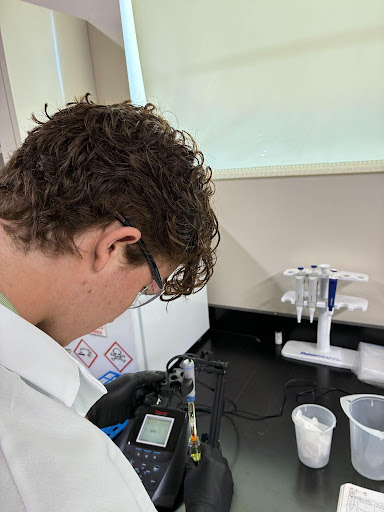
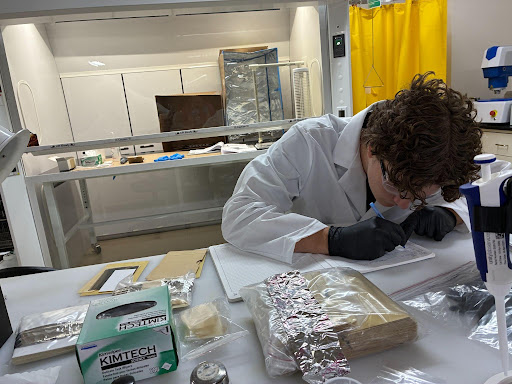
When I first toured the dry and wet labs during my orientation at The Museum, I was astonished by all of the state-of-the-art equipment and vast storage of historical materials used for heritage conservation. Specifically, my experience with heritage conservation involved testing Whatman #1 paper and glassine in contact with 20th-century film negatives in order to measure the effect their exposure to a weak or strong acid had on their pH. The methods for this experiment include pH testing using a variety of methods, including pH electrode acidity measurements, microchemical testing, and sample preparation/cold extraction experiments. Additional ion chromatography experiments help identify acids when present. My observations led me to conclude that the samples exposed to cellulose acetate had a higher pH than those exposed to cellulose nitrate because cellulose acetate is a weak acid while cellulose nitrate is a strong acid. This was a complicated experiment, and it required the heritage conservation resources and technology located at The Mariners’ Museum and Park.
I am extremely grateful for the access I had to scientific equipment, the extraordinary staff I got to collaborate with throughout my time here, and the extensive experience I received not just through furthering my knowledge of environmental science but also being able to see what it’s like to work in a combined lab and office setting.