Welcome back to the WILD Wednesdays series! This week, we will discuss one way our team approaches teaching local students about the impact of invasive species on our Park and local watershed. We are Amy Nicholson and Haleigh Bird, both Science Educators in the Education Department at The Mariners’ Museum and Park. Our job as educators is to connect students to our maritime mission by serving as a community resource, connecting them to their local watershed and giving them hands-on experiences related to the Virginia Standards of Learning (SOLs).
This week, we wanted to highlight our high school environmental science program, Lake Stewards. Lake Stewards is a meaningful watershed educational experience (MWEE) program that engages with environmental science students from Newport News City, York County, and Hampton City Public Schools.
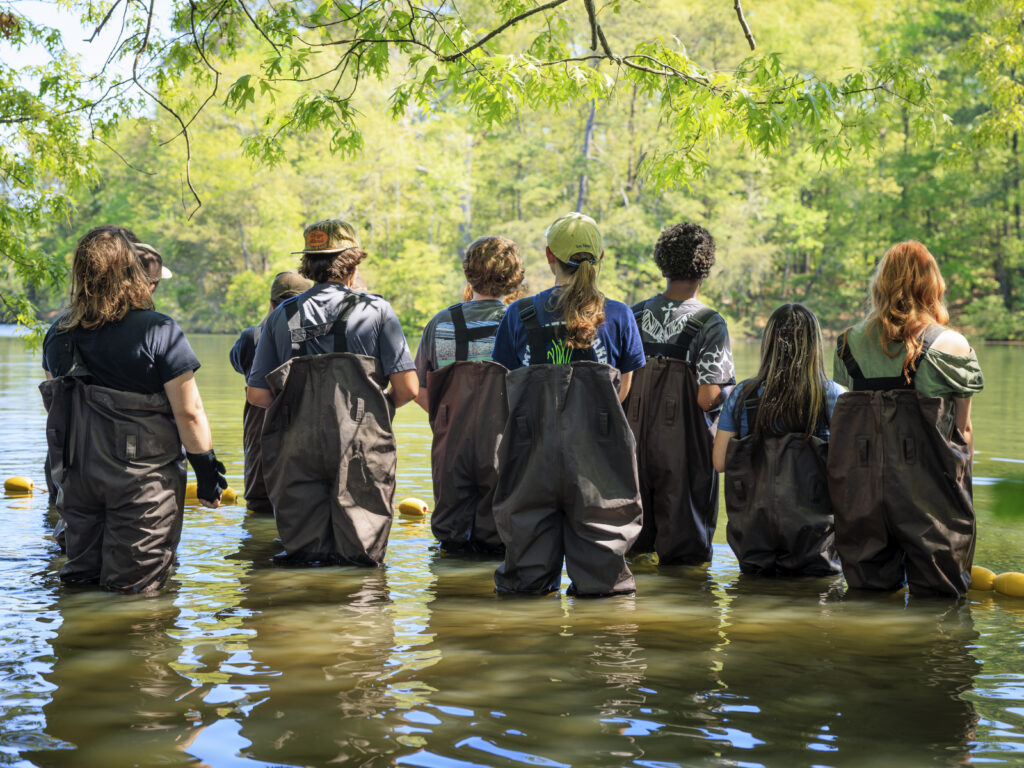
Students visit the Park for an hour-and-a-half field trip consisting of three stations: eelgrass planting, water quality, and land fishing. At the planting station, students wade into Mariners’ Lake and plant a native species of aquatic grass, Vallisneria americana. Students then move to the water quality station where they create and test a hypothesis by collecting data from Mariners’ Lake. Lastly, the students play a land fishing game, designed to teach them about native and invasive species that can be found in their local watershed. This past year, the fishing station was further gamified to increase student understanding of SOL-related content (Virginia Department of Education, 2025).
Why gamify?
So what is gamification? Simply put, gamification is the “process of adding gamelike elements to encourage participation” (Merriam-Webster, n.d.). As it stands, the definition is not specific to education; however, many educators have adopted the idea of gamification in their classrooms. Gamification in the classroom has been studied and implemented for years as a way to increase student motivation and comprehension of science topics (Kalogiannakis et al., 2021). We have found gamification applies in informal education as well!
The educational enrichment programs at The Mariners’ Museum and Park are based on SOL content delivered in students’ classrooms. The Mariners’ Education Team supplements what the students study at their desks with hands-on, interactive games that connect classroom content to our museum and park collection in new and exciting ways.
Gamification in Lake Stewards
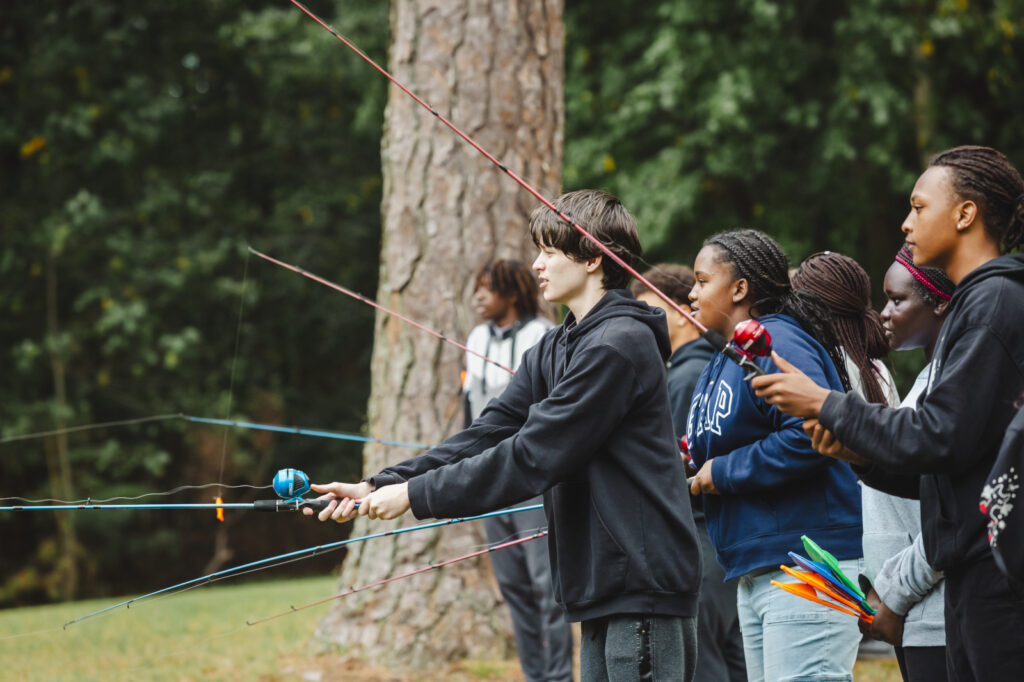
During the Lake Stewards program, students play a fishing game to create fun and lasting memories to learn about how human actions shape the environment. At this station, students use real fishing rods to catch plastic fish representing real species that can be found in Mariners’ Lake. To better replicate the ecosystem, there are also catchable items such as litter or waterfowl. After students have time to fish, an educator leads students in a discussion about native and invasive species. As mentioned earlier, to better help students connect to educational content, we have recently updated our fishing station.
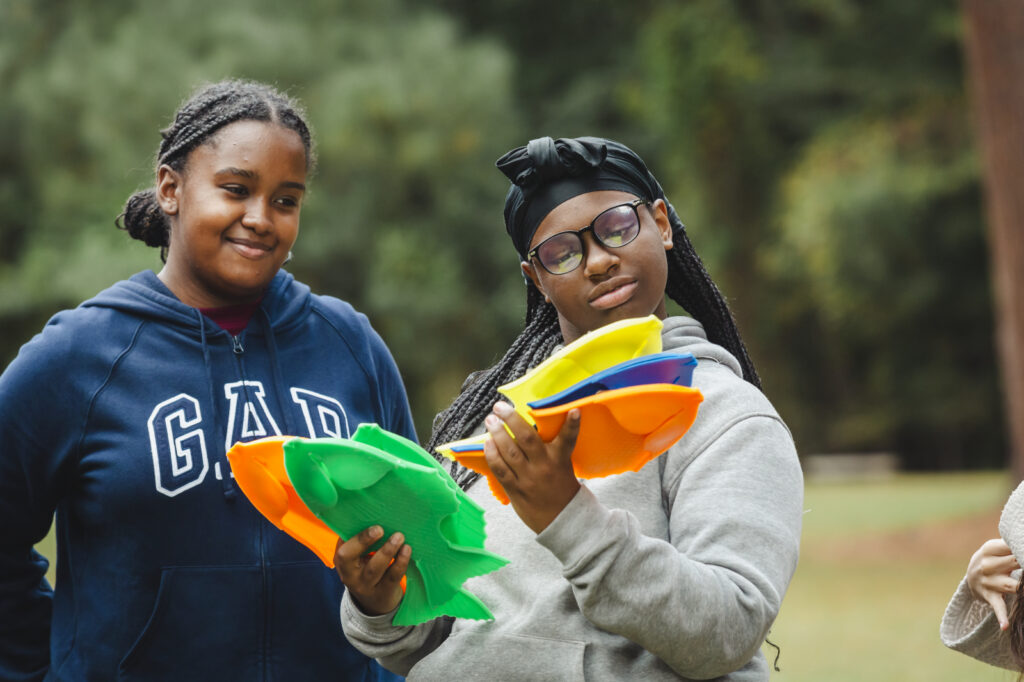
As it stood, the station was already a game, and very much so a competition. However, we noticed that students with more fishing experience would often quickly surpass those who were not as experienced. At the same time, students who were less successful at reeling in a catch would become uninterested. Another challenge we observed is that students struggled to make the connection that different species can impact ecosystems in different ways. To level the playing field and help students make a stronger connection between the content and the game, we further gamified the station with a few minor tweaks.
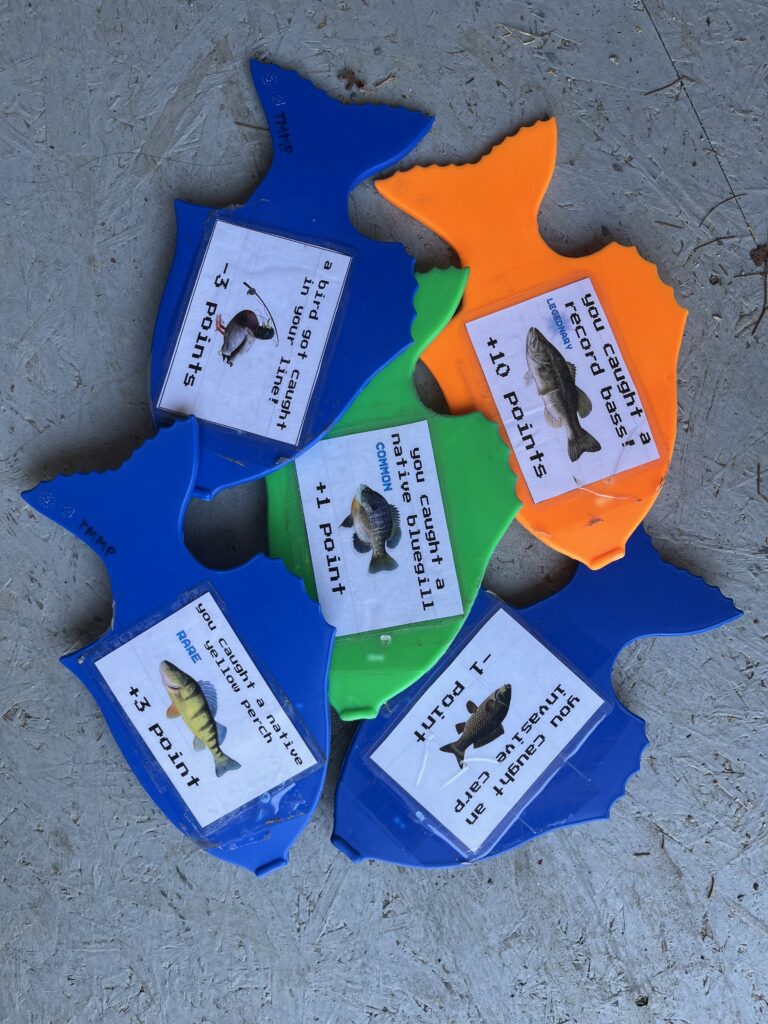
In the original game format, students caught plastic fish, which were labeled only with the type of fish and its conservation status (native, nonnative, or invasive). To help students strengthen their understanding of the negative impact of invasive species, point values were added to each species. Native species were assigned positive points while invasive species, litter, and tangled waterfowl were assigned negative points. Points range anywhere from -3 to +10 points, allowing students with only two or three fish to outcompete others with 10 or more (Table 1). We noticed that this not only increased competition amongst students, but also got them asking more questions about the meaning of the point values, helping to reinforce the content. Additionally, phrases such as “rare”, “epic”, and “legendary” were added to the conservation status to further foster a competitive, catch-em-all mindset amongst students.
| Name and Conservation Status | Point Value | Rarity |
| Tangled Waterfowl | -3 | N/A |
| Plastic Bag | -2 | N/A |
| Invasive Carp | -1 | N/A |
| Native Bluegill | +1 | Common |
| Native Gizzard Shad | +1 | Common |
| Native Largemouth Bass | +1 | Common |
| Native Crappie | +2 | Common |
| Native Yellow Perch | +3 | Rare |
| Native White Perch | +3 | Rare |
| Native Pumpkinseed | +3 | Rare |
| Record Bass | +10 | Legendary |
After students get about 15-20 minutes to fish, we wrap up with a discussion about the activity and what they discovered. First, students are asked to add up their points. This is where we got lots of friendly uproar as students realized that more fish doesn’t always equal more points. After we determine the “winner”, we ask students why they think certain fish may have positive or negative values. This is where the benefit of gamification really started to shine.
Using the familiarity of “points” and “rarity”, students quickly understand that positive points are good and negative points are bad. This helps students make the connection that native species are more favorable than non-native or invasive species. Finally, we discuss the harm that invasive species can cause and potential actions that can be taken by scientists and local fishermen to reduce the negative impact of invasive species.
With minor tweaks, we found that students leave with a greater understanding of the content. The joy of gamification, however, does not only come with the mechanics of using familiar game tactics to teach SOL-related content. The joy also comes in seeing students engaged by laughing, joking, competing with each other (and trust us, they get REALLY competitive), and making realizations in new and exciting ways.
Fostering social-emotional learning skills like these can help students in their social lives, but also help them increase classroom engagement and perform better in school (Martinez & Gomez, 2024). Overall, gamification is a light-hearted way of engaging with content that allows students to make meaningful connections not only with the material, but also with the outdoors and each other.
Become a Steward
While gamification is one strategy used to get students invested in higher-level environmental science topics, the hope is that their interest doesn’t stop there. Our goal for this program is that students feel a connection to and concern for their local watershed, inspiring the next generation of environmental stewards. To reinforce the stewardship mindset, students who participate in this program have the ability to conduct an action project at no cost to them or their school. They have the choice between a trash pick-up kit to reduce pollution in their local watershed or a native seed planting kit to support beneficial species in their environment.
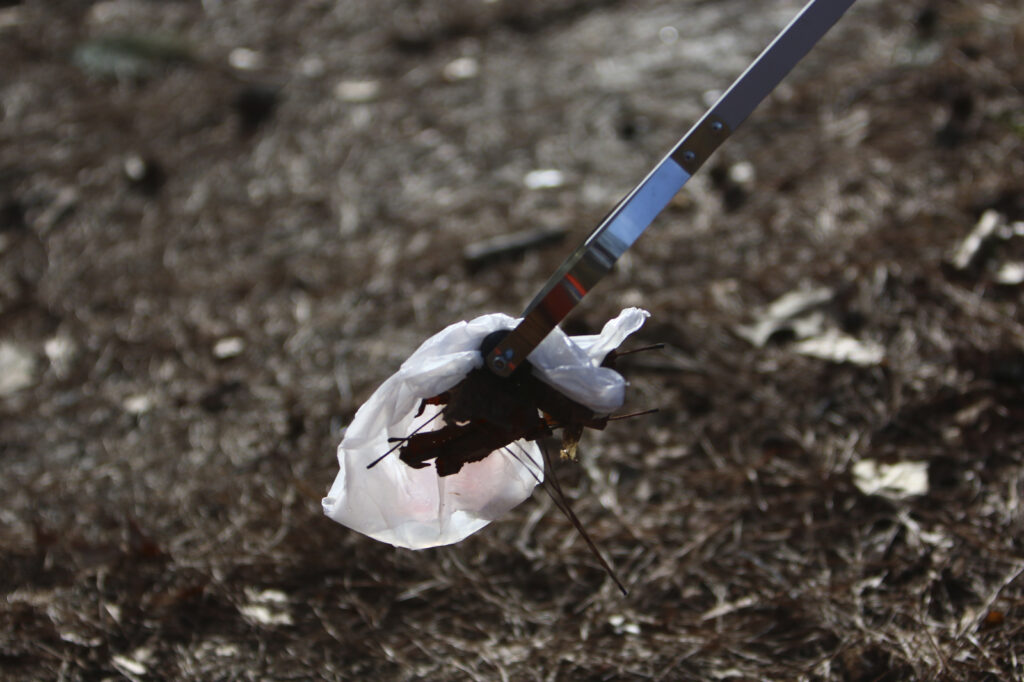
While Lake Stewards is a unique opportunity for local high school students, there are ways you can get involved as a steward of your local watershed: practicing Leave No Trace, recycling, or volunteering with local organizations. Volunteer opportunities with The Mariners’ Museum and Park for our WILD project will come up throughout the year. These volunteer days are usually half days (between two to three hours) and largely involve pulling targeted invasive plants or other related activities. We are slowing down in the warmer months, but will pick up again in the fall. If you are interested in volunteering on-site with us, please contact Volunteer and Internship Manager Beth Heaton at [email protected].
And lastly, for more background information on the Lake Stewards program, please visit this section of our website: https://www.marinersmuseum.org/conservation/environmental/lake-stewards/
Sources:
- Kalogiannakis, M., Papadakis, S., & Zourmpakis, A.-I. (2021). Gamification in Science Education. A Systematic Review of the Literature. Education Sciences, 11(1), 22. https://doi.org/10.3390/educsci11010022
- Martinez, Maria Eugenia, & Gomez, Valeria. (2024). The importance of social-emotional learning in schools. Acta Pedagogia Asiana, 3(2), 101–112. https://doi.org/10.53623/apga.v3i2.468
- Merriam-Webster. (n.d.). Gamification. In Merriam-Webster.com dictionary. Retrieved June 23, 2026, from https://www.merriam-webster.com/dictionary/gamification
- Virginia Department of Education. (2025). Standards of learning: Science. Virginia Department of Education. Retrieved June 23, 2026, from Virginia Department of Education Science Standards of Learning