This website stores cookies on your computer. These cookies are used to collect information about how you interact with our website and allow us to remember you. We use this information in order to improve and customize your browsing experience and for analytics and metrics about our visitors both on this website and other media. To find out more about the cookies we use, see our Privacy Policy.
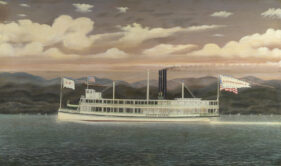
I found a small logbook dating from the Civil War kept by the captain of the steamer Andrew Harder. But my choice of Log 192 involved an inherent mystery we had hoped Thomas might be able to solve for us. Who was this diarist?
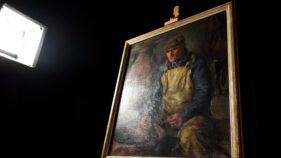
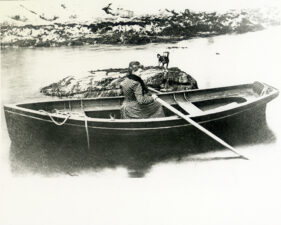
This stunning portrait of a blue-collar, immigrant fisherman takes us on a voyage of “why’s” and “why not’s” that brings us back to the heart of our mission here at The Mariners’.
Able, courageous, and experienced, Franklin Buchanan was perhaps the most aggressive senior officer to join the Confederate Navy. His strategic flair, discipline, and heroic qualities made him respected and admired by all those around him. After being put in command of CSS Virginia, Buchanan led efforts that resulted in the Confederacy’s greatest naval victory before being appointed as the first Admiral in the Confederate Navy and selected to command the naval defenses in Mobile Bay, Alabama. As Admiral, he oversaw the construction of multiple ironclads and was on board CSS Tennesee during its battle against David Glasgow Farragut’s Union Fleet in 1864.
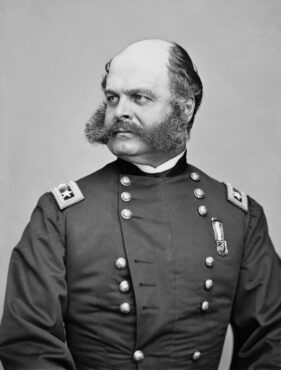
Brigadier General Ambrose E. Burnside’s invasion of the North Carolina inland seas was a major success. In seven days, Burnside, with the support of Flag Officer L.M. Goldsborough’s naval forces, had captured Currituck, Albemarle, Roanoke, and Croatan Sounds. This placed Burnside’s army in a position to capture his next objective, New Bern, North Carolina.
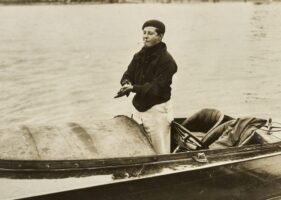
Marion Barbara “Joe” Carstairs would be the first to tell you that she was “never a little girl.” Joe saw a lot of racing success, taking the trophies at several competitions in Southampton and Cannes. In 1925 Joe became “the fastest woman on water” during the Duke of York’s Trophy, a four-and-a-half mile race down the Thames.