My Cart
  • Library and Archives

    The Mariners' Library and Archives hold the largest maritime history collection in the Western Hemisphere. With its rich collections and international scope, the Library and Archives is a premier resource for maritime research.

  • Native American Heritage Month~ Explored Through the Adney Collection of Canoe Models

    • Collections
    • Cultural Heritage

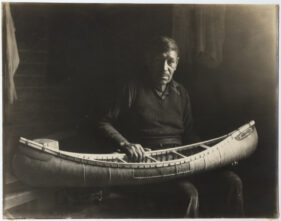
    The Edwin Tappan Adney collection at The Mariners’ Museum and Park include 120 canoe models. For Adney (1868-1950) building canoe models was not a hobby. He felt that it was his duty to document as many of the boats as he could. 

  • Worden and the Manifest Destiny

    The expansionist ideals of Manifest Destiny pushed the United States into conflict with Mexico, with disputes over Texas and the Rio Grande sparking the Mexican-American War. During this period, young naval officer John L. Worden sought active duty, earning promotion and serving aboard USS Southampton, where he played a key role in supplying and supporting American operations along the Pacific coast and in Baja California.

  • La Isabel Project: Part Three

    • Collections
    • Conservation

    Analysis is an important part of conservation because identifying specific materials in an artifact helps us better understand how an artifact degrades, its history, and much more. For La Isabel, we were interested in learning more about two specific materials: wood and fibers.

  • Battle of Port Royal Sound

    • Black History
    • Civil War
    • Military Conflict

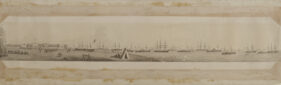
    The Civil War’s second major amphibious operation was the capture of Port Royal Sound on November 7, 1861.

  • Remembering their Sacrifice: The 77th Anniversary of D-Day

    • Military
    • Military Conflict
    • Photography

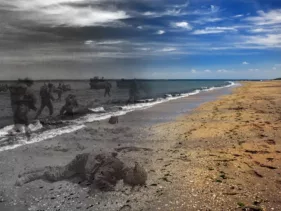
    All along the 50-mile Normandy coast there are places and moments for remembering the sacrifice made by the allied forces. As a photographer I was struck by the contrast between the modern beaches, and the horrific battles that occurred in 1944. Most days the beaches were near empty or filled with groups of tourists, much like they might have been before the war

Scroll to Top